
Microsoft's Word Legal Agent: A 90-Day Playbook Decision for Mid-Sized Firms
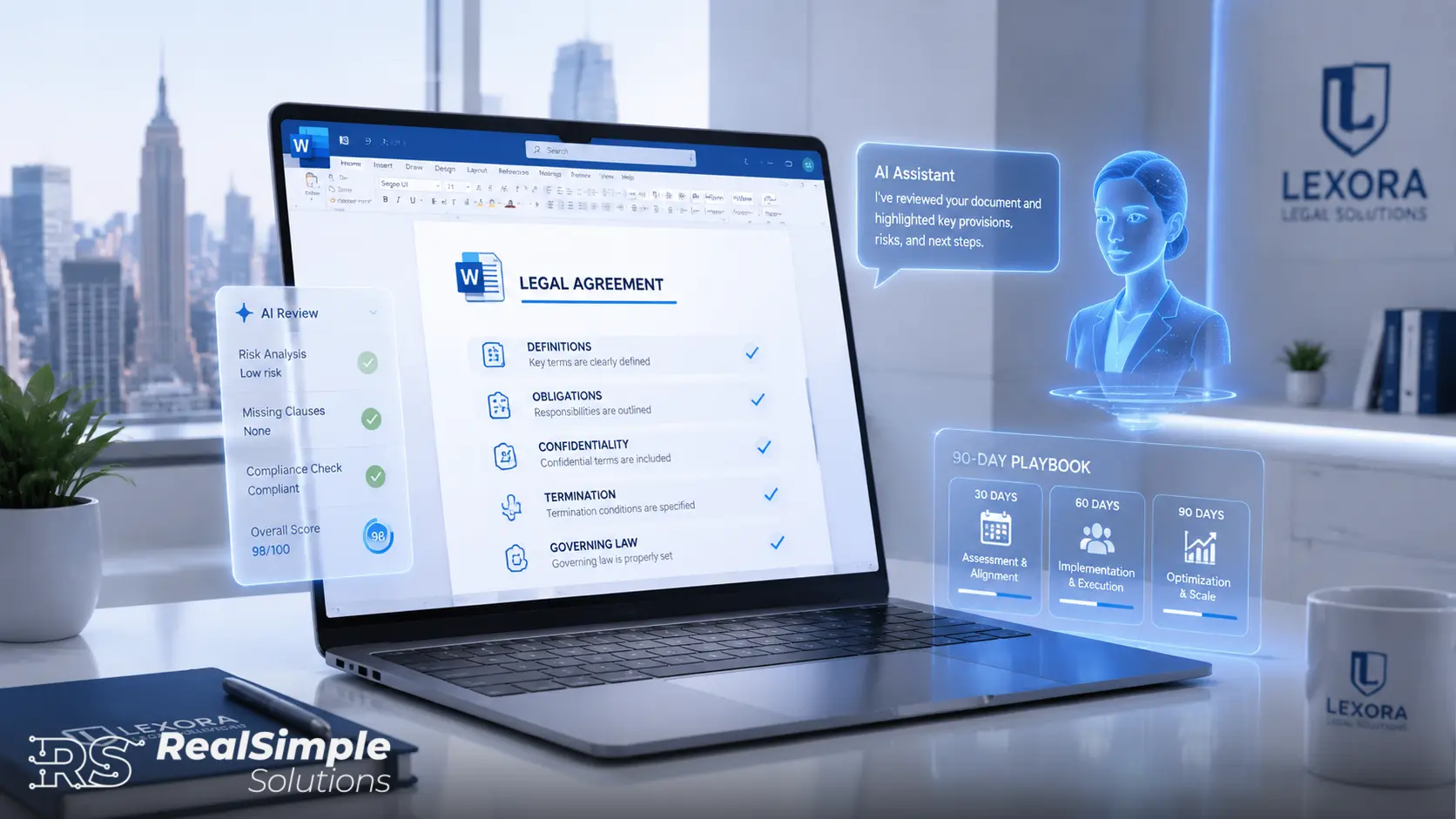
Table of Contents
- What shipped
- Where it earns its keep on day one
- The work the firm brings
- Where this approach breaks down
- A 90-day path to first value
- What to do this week
icrosoft's Legal Agent shipped inside Word on April 30, 2026, available now through the Microsoft 365 Frontier early-access program to US tenants with a Microsoft 365 Copilot license (Microsoft 365 Copilot Blog). It runs clause-level review, version comparison, and tracked-change redlining inside the document an attorney is already in. The capability is real. What separates the firms that get value from the ones that get generic output is the playbook, the data, and the integration work the announcement does not mention.
What shipped
The agent does three things, and the design is more interesting than the marketing.
It compares a contract under review to a playbook the firm provides, surfacing non-conforming provisions and proposing edits aligned to the firm's preferred and fallback language. It identifies what changed, what is risky, and what is novel when a counterparty sends back a redline. And it generates negotiation-ready tracked changes that preserve original formatting, with citations linking to the source language (Microsoft Support: Get started with the Legal Agent).
One technical choice matters operationally. Microsoft built a deterministic resolution layer that applies the agent's edits to the document, rather than asking the LLM to rewrite the document directly. That is why redlines preserve formatting, lists, and tables. It is also why a partner can trust the output enough to read it for substance instead of fighting Word over what got broken.
The Legal Agent uses Anthropic's Claude models as a subprocessor, and the firm's tenant has to enable Anthropic in Copilot settings before the agent will run (Microsoft Learn: Anthropic as a subprocessor). That is a procurement conversation, not a configuration step — some firms have policies that govern which subprocessors can be enabled, and the answer needs to come from the managing partner, not the IT lead.
Where it earns its keep on day one
The use cases that pay back the license cost in the first month are the high-volume, recurring contract types most 5-50 attorney firms see every week.
Start with standard commercial work: NDAs, MSAs, vendor agreements, employment offers, engagement letters. Preferred language is well-established, deviations are predictable, and a clause-by-clause comparison against a playbook is exactly what a junior associate or contract specialist does manually today. Counterparty redline review is the second high-value pattern. The agent surfaces what changed, what aligns with the firm's playbook, and what does not. For partners who currently read every line to identify changes before reviewing for substance, that surfacing is meaningful time back.
First-pass drafting against a known template is the third. Pulling from a template, adjusting for deal terms, and producing a draft ready for partner review is mechanical work, provided the template and the playbook are codified.
These are the categories where most firms underestimate their own volume. Standard commercial review across a 20-attorney firm is usually larger than partners think, because it is distributed across associates and paralegals who do not always book time precisely. The Frontier rollout has a real shot at recovering a chunk of that distributed time — but only when targeted at codified contract types, which brings us to the work the firm has to do.
The work the firm brings
Three areas where Microsoft built the tool and the firm builds the rest.
Playbook authoring. The agent is only as good as the playbook it runs against. A thin playbook produces thin output. Codifying a real one is partner-led work: preferred language for each material clause, fallback language for negotiated positions, walk-away triggers, and the partner-attention triggers that flag a deal up the chain. Most firms have this knowledge sitting in the heads of two or three senior partners. Writing it down pays back across every contract review, every associate training cycle, and every lateral onboarding. The agent is the forcing function.
Review checkpoints. Defining when an associate, a partner, or no one reviews the agent's output. Firms that skip this step default to one of two failure modes. They re-review every output line by line, capturing time savings only at the partner-judgment layer. Or they wave outputs through with a glance, adding risk where there was none before. A clear policy by contract type, by deal size, and by client risk profile turns the agent from a tool into a process.
Matter management integration. The agent runs inside Word. Word does not, on its own, push redlines, citations, or version history into Practice Panther, Clio, NetDocuments, or iManage. Without that integration, output lives in a partner's local Word session and dies when the matter closes. The institutional learning that should be the most valuable byproduct of using the tool never accrues. What got negotiated, by whom, against which counterparty, with what outcome: gone the moment the document is filed. Firms with historical contracts scattered across email, two generations of document management systems, and an iManage instance no one logs into anymore are not in a position to feed the agent good source material. A retrieval layer over the firm's own corpus, properly governed, is what turns "agent that runs a playbook" into "agent that knows how this firm has negotiated this clause for the last five years." If the output reads generic, the issue is rarely the agent. It is the data and the playbook.
Where this approach breaks down
Three places.
The agent is strong on standard commercial contracts and weaker on bespoke or heavily regulated agreements. Highly structured M&A documents, securities filings, and sector-specific regulated agreements sit at the edge of what the Legal Agent reliably handles (Microsoft Support). Scope use cases honestly rather than discover the limit on a live deal.
Playbooks compare against codified preferred language, not against current case law. Anything that turns on a recent or contested ruling, an unsettled regulatory question, or a novel fact pattern still needs human review of the agent's output. The agent will produce a redline aligned to the playbook. Whether the playbook itself is current is the firm's responsibility, not Microsoft's.
The third edge case is geographic. Anthropic models are excluded from the EU Data Boundary, and customers inside the EU and UK have Anthropic disabled by default (Microsoft Learn). For US firms with London offices or EU-based clients whose matters touch tenants in those regions, the agent's availability is not uniform across the firm. That is a procurement question to surface before deployment, not after a partner in the London office files a ticket asking why the agent does not appear in their Word.
A 90-day path to first value
For a 5-50 attorney firm with Frontier access, here is a sequence that produces measurable lift inside a quarter.
List the three contract types that account for the majority of your firm's review volume. For most general-practice firms, that is NDAs, vendor agreements, and engagement letters. For transactional firms, it is often commercial leases, MSAs, and SOWs. Pick what is true for the firm.
Allocate two days of partner time per contract type to codify each into a playbook. The deliverable is a document with preferred language, fallback language, walk-away triggers, and partner-attention triggers. This is the work that makes the rest of the deployment pay back.
Define one review checkpoint per contract type. Who reviews the agent's output, when, and against what criteria. Write it down so the answer does not depend on which partner happens to be in the room.
Run the agent in parallel with existing review for two weeks. Measure two things: accuracy of the agent's redlines against partner-final language, and time-to-redline against the firm's existing baseline. Use the firm's own contracts.
Decide on expansion based on the data the firm just produced. If lift is real and accuracy is acceptable, extend to the next two contract types. If either is below threshold, the issue is almost always the playbook or the data. Fix that and re-measure before blaming the tool.
The firms that get value from the Legal Agent in 2026 are not the ones with the deepest pockets or the earliest Frontier enrollment. They are the ones willing to do the playbook authoring, the checkpoint definition, and the integration work that the announcement does not mention because the announcement is about the tool, not the firm.
What to do this week
The capability is real. The work the firm brings to it determines the return. The action that matters most this week takes thirty minutes: pick the three contract types your firm would build a playbook for first, and name who at the firm owns each one.